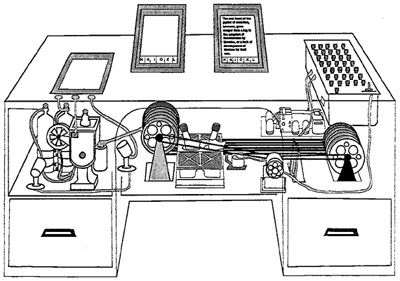
(the memex, screens on top look a bit like the iPad, don't they?)
Vannevar Bush was truly a visionary. He was the director of the Office of Scientific Research and Development, which controlled the Manhattan Project. He made predictions about the future of technology that at the time, probably ridiculous, but in reality are not too far off from what we use on a day-to-day basis. In his article “As We May Think” (1945) he basically predicted many of the tools we use in the present, before people even had computers. He was making this stuff up completely, without any real technological predecessor.

At the beginning of the article, Bush talks about the “minicamera.” This device would take small photos, and the film would have at least one hundred exposures (a standard roll of film has usually 24 to 36 exposures). The photos would be immediately visible after they were taken as well, which would be called “dry photography.” This is a lot like our modern day point and shoot camera. Digital cameras can hold up to hundreds of exposures or even more depending on the size of the memory card, and as soon as one takes a photograph, they can view it immediately on the camera itself.

He used the term “microphotography” to describe how images that were made from the minicamera, using “dry photography” could be projected large, but were shot small so that they wouldn’t take up a lot of room. Bush states in his article, “The Encyclopedia Britannica could be reduced to the size of a matchbox” when describing how these tiny images could be “assembled and compressed.” This process is a lot less advanced version of compressing files on a computer to save room, and unzipping them to access the files.

The two most amazing predictions Bush made in his article though, have to be the “memex” and basically the Internet in its entirety. The “memex” would be a machine that one would have for personal use. One could access anything, with a screen. The machine would flip through thousands of mini-photographs, picking one from cues that the owner would type in. Basically, what Bush was describing was the modern day computer. He does not stop there though, he goes on to talk about how “new forms of encyclopedias will appear” and that “we may some day click off arguments on a machine with
the same assurance that we now enter sales on a cash register.” The new forms of encyclopedias would be the access to all the information that the Internet holds, the Internet itself. Being able to click out of an argument is what personally, I believe is one of the more common forms of arguing now. We have YouTube commenters screaming at one another, blog commenters battling, acting tough behind the keyboard, and debate forums. All of these things exist on the Internet and could all be easily checked out of. Bush could not have described the “future of argumentation” any better. “As We May Think” is not that large of an article, but it is so dense in accurate predictions that it is beyond mind-blowing to read and to think that just one man came up with devices people use internationally every day.
